
Exploring the Future of Tree Species Identification
Generic AI Tools vs. Experienced Arborists
Discover how technology is transforming the way we identify tree species, and how it compares to traditional methods used by arborists. Using low cost generic AI tools we explore what works and what doesn’t.
Understanding Tree Species Identification
Identifying tree species accurately is crucial for biodiversity conservation, forest management, and ecological research. Traditionally, arborists have relied on their expertise to identify species and plant health from the ground, examining leaves, bark, and other physical characteristics.
Advancements in technology, AI driven methods using aerial drone imagery are emerging as a powerful tool. This comparison highlights the significance of integrating AI with traditional techniques to enhance accuracy and efficiency. As we delve into the intricacies of both approaches, we aim to uncover the strengths and limitations of each, providing insights into how they can complement each other in the field of forestry and environmental science.
Our examination focuses on the use of commonly available AI, Grok AI (xAI). There are many other AI solutions that are better suited for plant identification. They are also out of reach to the common user due to cost and technical requirements. For that reason, we focus on the most accessible tools as we continue to find useful ways for the common person to employ AI in the real world.
AI-Driven Tree Identification
How AI Utilizes Drone Imagery
AI tree species identification leverages high resolution aerial imagery captured by drones to analyze and classify tree species. This method employs machine learning algorithms that process visual data, recognizing patterns and features unique to different species. The advantages of this approach include the ability to cover large areas quickly, access to remote or difficult terrains, and the potential for real-time monitoring. However, AI methods also face limitations, such as the need for extensive training datasets to improve accuracy and the challenge of distinguishing species with similar visual characteristics. By choosing Grok AI for our experiment, we avoided the need to train the model and relied instead on the built-in algorithms to analyze the imagery.
Grok AI did more than analyze the image, it analyzed all of the information provided in the chat prompt and then searched all accessible resources to formulate a response.
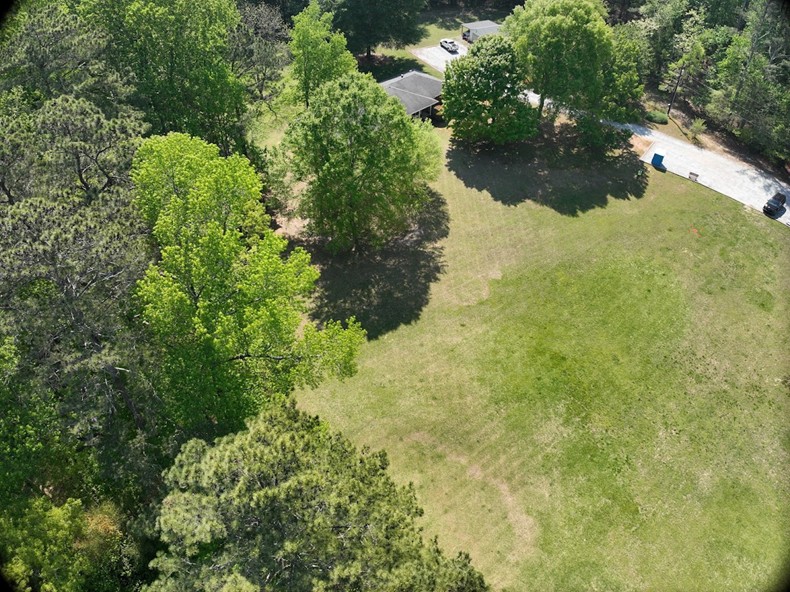
The Grok AI Chat Prompt : “Analyze aerial drone image of a group of trees in Homecoming Park, Dunwoody, GA taken in May 2025 with a DJI Matrice 4E and identify their species. Provide the common and scientific name, along with key visual characteristics that support your identification, and a health evaluation based on canopy condition, leaf health, and bark appearance. Highlight any signs of disease or environmental stress.”
For AI to work, it needs more information than you would provide a human who can physically see and touch the trees. AI needs context. In the case of tree species identification it needs location and time of year.
The month of the year is an indicator of the trees stage of development from leafing or leaf emergence to abscission or the dropping of leaves. In the Spring, many trees form buds as they come out of dormancy. Some species will begin leafing early to maximize the growing season while late leafing species avoid exposing new growth too soon. During the leafing process, the leaves may change in color and size as they mature. Knowing the month of the year aides in determining the expected stage of development and the tree species.
The geographic location of the trees being examined helps to narrow down the potential species list. With approximately 3 trillion trees comprised of 73,000 species on Earth (this includes around 9,000 species that are yet to be discovered), location matters. In the U.S. it is estimated there are approximately 228 billion trees comprised on 881 species. According to the US Department of Agriculture, there are approximately 43 billion live trees comprised of 250 species in Georgia. Knowing the location substantially reduces the number of comparisons required to determine the species of our tree sample.
Time of day can also be a consideration as it can impact the color and shape of the leaves. Some trees angle their leaves towards the sunlight during the day, while others may closes their leaves in the evening. The changes in the wavelengths of light between morning and evening can trigger chemical processes in the leaves which may cause changes in their characteristics.
Ground-Based Identification Techniques
Traditional Arborist Methods
Arborists have long relied on a combination of visual inspection, botanical knowledge, and physical examination to identify tree species. These professionals use their expertise to assess leaf shape, bark texture, and other physical characteristics. While this method allows for a detailed, hands-on approach, it can be time consuming and is limited by the arborist’s accessibility to the trees.

David Alexander, Parks & Grounds Coordinator
Starting with a knowledge of the local area and most common species, they observe and analyze the characteristic of the tree. Leaf shapes, size, and arrangement provide clues. Identifying distinct shapes like those of oak or maple versus the needles of pines, spruces and firs. Looking at how the leave or needles are attached to the stem. Noting the configuration of the leaf edges, there size and color.
The bark of the tree offers valuable hints based on its texture, color and other identifying features. The shape and growth pattern, v-shaped elms versus columnar sweetgums. If flowers, fruits or seeds are visible, they can be very helpful with identification. These observations can then be applied to field guides to assist in identification or to confirm observations.
One of the strengths of traditional arborist identification is the ability to assess tree health and environmental context directly. However, the process can be labor-intensive and may not be feasible for large scale surveys.
AI Comes in Many Flavors
There are many flavors of AI (artificial intelligence) and each flavor has it strong points and weak points. Identifying the correct AI tool for the task directly impacts the outcome. Our selection process includes a consideration of cost and availability. We chose AI tools that are commonly available to the average person rather than a high end models specifically designed or better suited for the task of plant identification. The purpose of our experiment is to evaluate real world use cases of free or cost effective and accessible AI tools.
Grok AI – a conversational generative AI designed to be a powerful AI assistant capable of generating text, accessing real-time information and creating images.
ChatGPT is a generative AI and large language model (LLM) specifically designed for conversation interactions.
Gemini is a multimodal large language model (LLM) designed to handle various types of information including text, images, audio and code.
Deeping Learning Model and Convolutional Neural Networks (CNN) are better suited for performing identifications. These solutions are not commonly or freely available. They are also not easy to use. Again, the point of this exercise is to determine everyday use cases for common AI tools.
Of the common AI solutions we evaluated, Grok AI is the most conversational. ChatGPT is like talking to a textbook. Gemini is somewhere between the two. All of the AI solutions want more than one image angle and/or format. When you give them more, it is not enough to make a definitive species identification. Without specific visual cues like leaves, bark or distinctive crown shapes for every tree, a general analysis is the best they can provide. Since the AI solution will be given the geographic location of the images, they are able to narrow down their identification to species in the region in conjunction with visual observations.
Extra points to Grok AI for having the most interesting answer when asked what type of AI it is?
“I’m Grok, created by xAI. I’m a general-purpose conversational AI designed to provide helpful and truthful answers across a wide range of topics. Think of me as a versatile, knowledge-seeking assistant, inspired by the likes of the Hitchhiker’s Guide to the Galaxy and JARVIS from Iron Man. My core strength is in reasoning, analyzing information, and offering insights with a dash of outside perspective on humanity. I can tap into real-time data through web searches and X posts when needed, and I’m built to assist with everything from casual questions to complex problem-solving. What’s on your mind? Want to explore the universe together?”
AI vs Arborist Summary Results
Our arborist, David Alexander, grew up in the neighborhood. His office is located on the park grounds where the aerial drone image was captured. He has deep knowledge and familiarity with the trees that he looks at each and every day. In terms of turn around time for a response, I was able to have results from AI immediately after uploading the image. Our arborist has a fulltime job and it took a day or three to get a response. As they say, do you want it fast, cheap or good? Pick two because you cant have all three. I trust the response from the arborist over AI in this instance. Granted, there are better AI tools but our experiment is with commonly available, cost effective or free tools. In this case the results are clear. The arborist wins but that is not the end of the story.
Arborist Identification
Loblolly Pine identified by size and leaf from image
Sweetgum identified by leaf shape from image
Water Oak identified by leaf shape from tree visit
Red Maple identified by familiarity with the tree
Water Oak- familiarity
Pin Oak, 85 percent certainty based on leaf shape
Black Walnut- familiarity
AI Identification
Loblolly Pine (Pinus taeda)
White Oak (Quercus alba)
Red Maple (Acer rubrum)
Tulip Poplar (Liriodendron tulipifera)
? What about the rest ?
The final answer is not that the arborist won in this experiment. It’s that technology can play a role, and that role is evolving. The arborist used the aerial drone imagery to see the canopy (not visible from the ground) to help with identification. David is a trained arborist with many years of experience. We used a commonly available, generic AI tool, Grok AI, which was not specifically trained to identify tree species. AI was able to provide a reasonable health assessment and a starting point for deeper evaluation by an arborist. The combination of the arborist, AI, and drone imagery provided the final answer. In a large dataset or acres of trees, drones can quickly provide the aerial imagery, AI can quickly point out areas of interest or concern, and the well calibrated eyeball of an arborist can make the final judgement.
More Words Does Not Mean Better Answer
AI Detailed Results
Grok AI Analysis of Aerial Drone Image: Tree Species Identification in Homecoming Park, Dunwoody, GA (May 2025, DJI Matrice 4E)
This aerial image, captured in May 2025 during peak spring foliage in the Piedmont region of Georgia, depicts a mixed woodland edge in Homecoming Park adjacent to an open grassy field and a small structure (likely a pavilion). The canopy shows a diverse group of approximately 15-20 mature trees, with distinct groupings of coniferous and deciduous species. The resolution from the DJI Matrice 4E allows for clear differentiation of crown shapes, needle vs. broadleaf textures, and subtle color variations in the vibrant green foliage. Based on visual cues like crown architecture, leaf density, branching patterns, and regional ecology (Piedmont mixed oak-pine-hickory forests), I’ve identified the dominant species below. Identifications prioritize native species common to Dunwoody’s urban-forested parks, such as loblolly pine and various hardwoods.
Trees are grouped by apparent species for clarity, with evaluations focusing on canopy condition (density/fullness), leaf health (color uniformity, spotting), and bark appearance (visible lower trunks show textures like flaking or ridges). Overall, the stand appears healthy for a suburban park setting, with lush May growth masking minor stressors; however, proximity to mowed fields and roads may contribute to isolated edge effects.
- Loblolly Pine (Pinus taeda)
- Key Visual Characteristics Supporting Identification**: These are the prominent coniferous trees on the left and upper edges, forming a dense cluster of 6-8 individuals. From above, they exhibit pyramidal to irregular oval crowns with rounded tops, typical of mature loblolly pines (40-60 ft tall here). The fine-textured, dark green “fuzzy” appearance results from 8-12 inch needles in bundles of three, densely packed without the coarser tufts seen in shortleaf pine. Straight trunks and open branching lower down align with this fast-growing Piedmont dominant, which often pioneers disturbed sites like park edges.
- Health Evaluation:
- Canopy Condition: Full and symmetrical, with no dieback or thinning; uniform density suggests vigorous growth.
- Leaf Health: Bright, even green needles show no yellowing or sparse patches indicative of nutrient deficiency.
- Bark Appearance: Lower trunks visible in gaps display reddish-brown, scaly plates—healthy texture without cracks or oozing.
- Signs of Disease or Environmental Stress: None evident. No needle cast (brown tips) from fusiform rust, a common southern pine issue, or southern pine beetle damage (e.g., pitch tubes). Minor wind exposure at the edge may cause slight needle shear, but overall resilience to urban stressors like air pollution is strong.
- White Oak (Quercus alba)
- Key Visual Characteristics Supporting Identification: Scattered among the hardwoods (3-4 individuals, central and right side), these broad-crowned trees stand out with rounded, dome-like canopies (50-70 ft spread) that create broad shade patterns over the field. The coarse, blocky leaf texture from above gives a mottled green look, distinct from smoother sweetgum leaves. Lobed leaves (visible as subtle outlines) and horizontal branching match this keystone Piedmont oak, Georgia’s state tree, which thrives in well-drained park soils.
- Health Evaluation:
- Canopy Condition: Dense and layered, with full branching to the ground; no gaps from branch drop.
- Leaf Health: Uniform medium green, no chlorosis or sparse foliage signaling oak wilt.
- Bark Appearance: Light gray, ridged-and-furrowed bark on exposed trunks appears intact and weathered naturally.
- Signs of Disease or Environmental Stress: Minimal. Slight asymmetry in one canopy (possible old pruning scar) but no gypsy moth defoliation or hypoxylon canker (black streaks). Urban drought stress could emerge later in summer, but May vigor indicates good hydration from recent rains.
- Red Maple (Acer rubrum)
- Key Visual Characteristics Supporting Identification: The 4-5 smaller, vase-shaped trees near the structure and field edge have upright, oval crowns with fine-textured, bright green leaves—palmate lobes create a lighter, airier look than oaks. V-shaped branching and reddish new growth edges (subtle in May) are hallmarks of this adaptable Piedmont understory tree, common in moist park transitions. Height (30-50 ft) and tolerance for clay soils fit the site’s gentle slope.
- Health Evaluation:
- Canopy Condition: Compact and bushy, with even fill; youngish trees show no hedging from maintenance.
- Leaf Health: Fresh, glossy green without anthracnose spots (common in wet springs).
- Bark Appearance: Smooth, grayish on younger trunks; no peeling or wounds.
- Signs of Disease or Environmental Stress**: Low. One tree shows minor leaf curl (possible herbicide drift from field mowing), but no verticillium wilt (wilting branches) or tar spot. Flooding risk near the field is buffered by elevation, though root compaction from foot traffic could stress roots long-term.
- Tulip Poplar (Liriodendron tulipifera)
- Key Visual Characteristics Supporting Identification: The tallest hardwoods (2-3 individuals, upper right), with conical crowns rising above the canopy (60-80 ft). Straight, dominant central leader and large, squarish leaf shapes create a pyramidally dense, yellow-green texture—distinct from maples’ fineness. As a fast-growing climax species in Georgia Piedmont forests, it matches the park’s mesic wooded area.
- Health Evaluation:
- Canopy Condition: Towering and full, with minimal lower shading; epicormic sprouts absent.
- Leaf Health: Vibrant green, no browning edges from scorch.
- Bark Appearance: Dark gray, furrowed ridges on boles—healthy, without cankers.
- Signs of Disease or Environmental Stress: None prominent. No verticillium symptoms (vascular staining) or drought-induced tip dieback. As a moisture-lover, it may show yellowing in dry spells, but May’s humidity supports optimal health.
Overall Stand Assessment
This mixed group exemplifies a healthy Piedmont woodland remnant, with conifers providing year-round structure and hardwoods adding seasonal diversity. Canopy closure is about 80%, promoting biodiversity, while the open field interface allows sunlight penetration for understory growth. No widespread disease (e.g., laurel wilt in nearby laurels, not present) or stress like emerald ash borer (ash absent) is visible. Potential environmental pressures include urban edge effects—proximity to pavement may elevate soil compaction and pollutants—but the May 2025 timing captures pre-summer stress. Recommendations: Monitor for invasive undergrowth (e.g., privet) and consider selective thinning to enhance oak regeneration. This stand contributes positively to Dunwoody’s 150-mile tree canopy, supporting wildlife and flood mitigation.
Leveraging the Evolving Power of Technology
Read more about how technology is evolving. The robots are coming. Are you ready?
Improve Construction Progress Reporting with Drone Imagery
Discover how drone imagery is reshaping the landscape of construction progress reporting, providing unparalleled accuracy and efficiency. Experience precise site mapping with detailed aerial views that enhance decision-making. Visualize your projects in three...
Unveiling the Power of Drone Imagery
Explore how drone technology is revolutionizing industries by offering unparalleled views and insights, enhancing transparency and efficiency in City Storytelling, Construction, and Asset Inspection. In an era of tight budgets and high expectations, drone imagery has...
Concluding Thoughts on Tree Species Identification
In our exploration of tree species identification, we have delved into the capabilities and limitations of both AI driven aerial drone imagery and traditional arborist methods. While drones offer a broad perspective and efficiency in covering large areas, arborists provide detailed, ground-level insights that are invaluable for accurate assessments. Each method has its strengths, and the future likely holds a synergistic approach where technology and human expertise work hand in hand.
Unleash the Power of Drone Imagery
Ready to capture breathtaking aerial views, immersive 360° tours, or dynamic timelapse footage that sets your project apart? Whether you’re showcasing a construction milestone, marketing a dream home, or creating standout content for your business, our certified drone experts are here to craft custom imagery that delivers results.
Schedule Your Free Consultation Today – Let’s build a mission plan tailored just for you. Schedule now to transform your ideas into stunning visuals. Don’t wait – the sky’s the limit!